Historical origins and the first Muslim community
Islam emerged in seventh-century Arabia through the preaching of Muhammad, whom Muslims understand as the final prophet in a line that includes figures such as Abraham, Moses and Jesus. The Quran presents Muhammad as a messenger calling people to worship one God, live ethically and prepare for divine judgment.
The first Muslim community took shape in Mecca and Medina. After Muhammad's death, questions of leadership became especially important. Different understandings of legitimate authority contributed over time to the formation of Sunni and Shi'a traditions, although those labels themselves contain multiple schools and communities. Later legal, theological and devotional traditions added further layers that cannot be reduced to the politics of the earliest period.
The Quran, revelation and interpretation
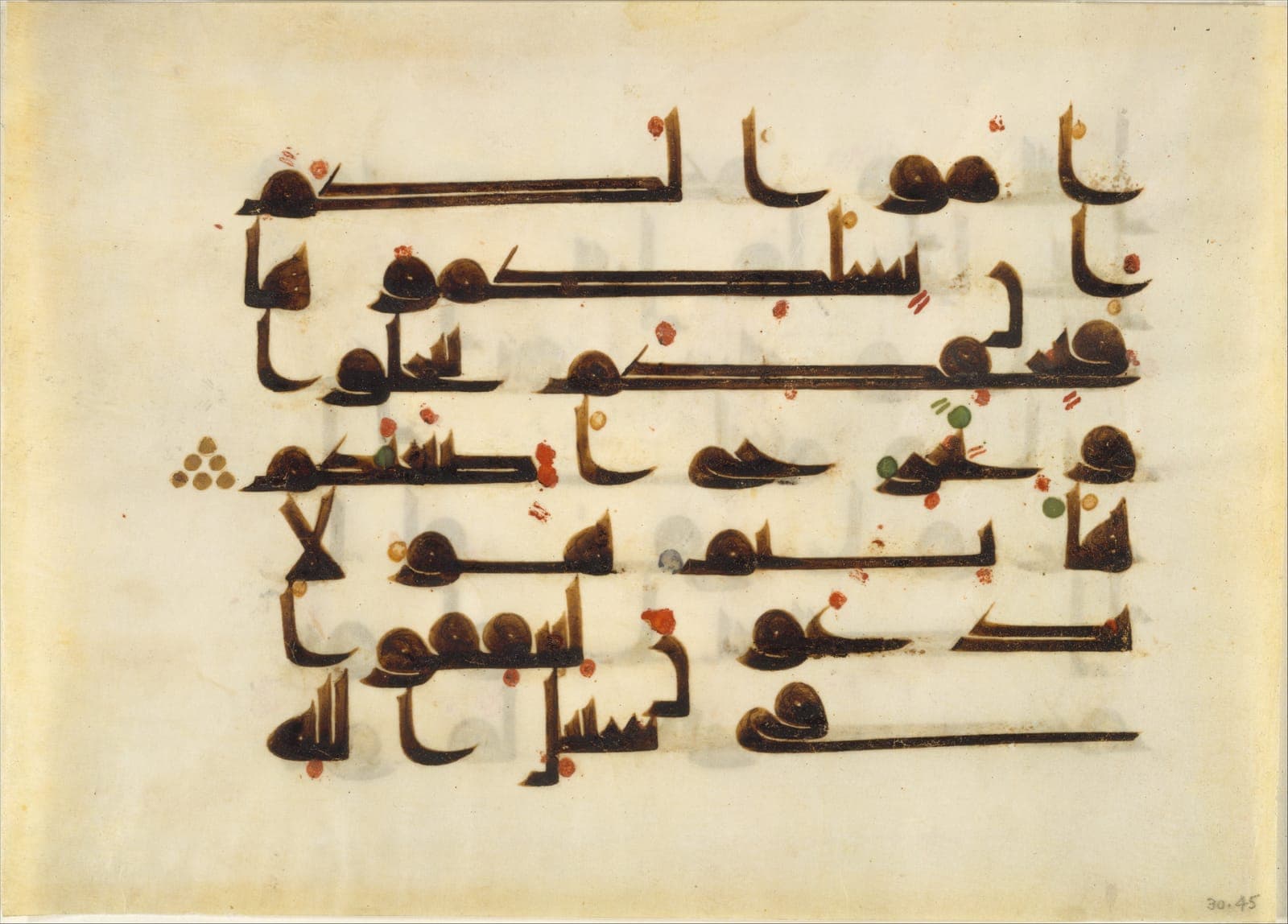
The Quran occupies the central scriptural position in Islam. Muslims understand it as divine revelation delivered to Muhammad, and the Arabic text has a distinctive status in worship and recitation. Translation is therefore not identical to the Quranic Arabic itself: an English rendering communicates a translator's understanding of meaning, and different translations can make different lexical and interpretive choices.
Muslim learning also draws on hadith, reports concerning the words and actions attributed to Muhammad, and on long traditions of Quranic interpretation, jurisprudence and theology. The authority and use of these materials are not identical in every school. It is therefore important to distinguish the Quran itself from later interpretation, rather than treating every Islamic statement as if it came directly from the same source.
God, prophecy and accountability
At the center of Islam is tawhid, the affirmation of God's oneness. Muslim belief also includes prophecy, revelation, moral accountability and the Day of Judgment. Muhammad holds a unique place as the final prophet in mainstream Islamic belief, while earlier prophetic figures remain important.
Jesus, for example, is honored in Islam as a prophetic and messianic figure but is not understood through the Trinitarian and incarnational framework used by mainstream Christianity. This shared vocabulary can make interreligious comparison look simpler than it is. The same name or story may sit inside a different theological structure.
Worship and the Five Pillars
A familiar Sunni summary of core religious practice is the Five Pillars: the testimony of faith, ritual prayer, obligatory almsgiving, fasting in Ramadan and pilgrimage to Mecca for those able to undertake it. These practices are widely recognizable across Muslim life, but Sunni and Shi'a systems do not organize every duty under exactly the same headings.
Ritual prayer gives a repeated daily rhythm to observant life. Ramadan joins fasting with prayer, Quran reading, generosity and communal gathering. Zakat has both legal and ethical dimensions, while voluntary charity extends beyond it. Hajj gathers Muslims from many regions around rites associated with Mecca and the history of Abrahamic devotion.
Worship is not limited to formal ritual. Muslim ethical teaching also addresses family obligations, commerce, speech, treatment of neighbors, care for people in need and personal character.
Sunni, Shi'a and Sufi traditions
Sunni Muslims form the largest broad branch of Islam, while Shi'a Muslims form another major family that includes Twelver, Isma'ili and Zaydi communities. The early dispute over leadership after Muhammad became connected with wider differences in religious authority, memory and doctrine.
Sufism describes devotional and spiritual traditions concerned with remembrance of God, moral purification and cultivated awareness of the divine. Sufi orders and teachers have existed in both Sunni and Shi'a settings, so Sufism does not fit neatly as a third denomination beside them.
These categories are useful orientation points, not complete maps of Muslim identity. Theology, jurisprudence, devotional affiliation, language, region and local institutions can overlap in different ways.
Mosques, learning and community life
Mosques are places of prayer and gathering, but Muslim community life also extends through homes, schools, charities, study circles and many other institutions. Religious learning may involve Quran recitation, hadith, law, theology, ethics and devotional practice.
There is no single worldwide institution that speaks for every Muslim. Institutions such as Al-Azhar or national religious authorities can be highly influential, yet their authority is not universal across all Sunni and Shi'a communities. The same caution applies to individual scholars and movements.
A global religion with many cultures
Muslims live across every major world region, and most Muslims are not Arab. Arabic has a special religious role because it is the language of the Quran, but Muslim cultures are expressed through many languages, cuisines, forms of dress, architecture, music, devotional customs and social institutions.
Cultural practice and religious requirement can overlap without being identical. A custom common in one Muslim-majority society may be rare elsewhere, while the same religious obligation may be expressed through different local forms.