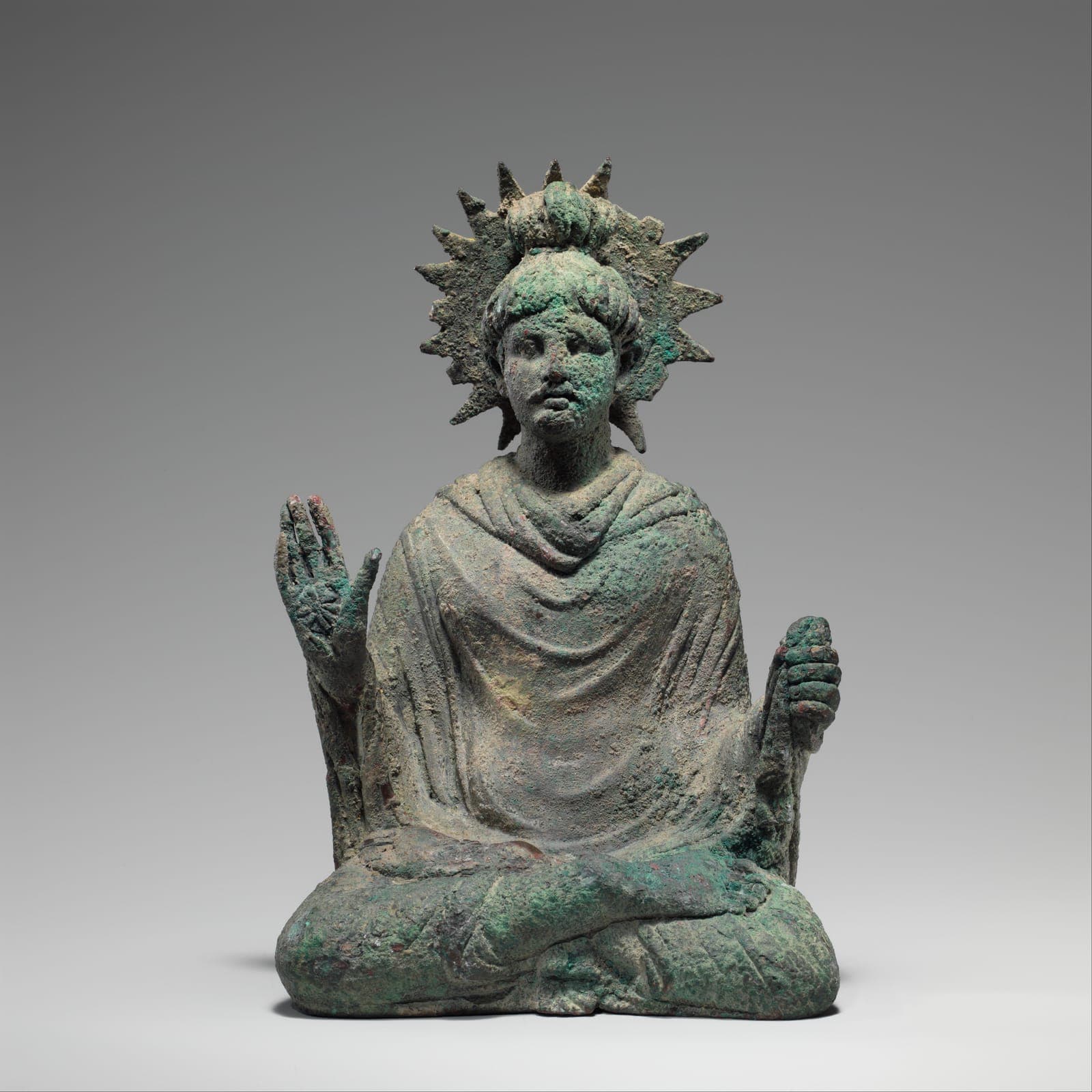
The Buddha and the early community
Siddhartha Gautama is remembered in Buddhist traditions as the Buddha, the "Awakened One." Early Buddhist communities formed around his teaching and preserved it through oral transmission before multiple textual collections developed.
The Buddha, Dharma or Dhamma, and Sangha became known as the Three Jewels or Three Refuges. The Buddha is the awakened teacher, Dharma is the teaching and path, and Sangha refers especially to the community of practitioners, with the scope of the term varying by context.
Historical scholarship and Buddhist sacred history answer different questions. Traditional accounts communicate religious meaning, while historians investigate chronology, institutions and textual development. Keeping those approaches distinct avoids presenting either one as if it were the only kind of history.
Four Noble Truths and the path
The Four Noble Truths are a foundational framework across major Buddhist traditions. They concern dukkha, often translated as suffering or unsatisfactoriness; its arising through craving and ignorance; the possibility of its cessation; and the path leading toward that cessation.
The Noble Eightfold Path organizes dimensions of understanding, intention, speech, action, livelihood, effort, mindfulness and concentration. Buddhist traditions explain and practice these factors in different ways, but the framework shows why Buddhism is not only a theory about suffering. It also describes an ethical and contemplative path.
Impermanence, not-self and dependent arising
Impermanence, not-self and dependent arising are foundational ideas in many Buddhist traditions. Conditioned experiences arise and pass rather than providing a permanent basis for identity or satisfaction.
The teaching of not-self challenges the idea of an eternal, unchanging self of the kind assumed by some other philosophical systems. Dependent arising emphasizes that phenomena occur through conditions rather than existing independently.
Later Buddhist traditions developed sophisticated accounts of emptiness, Buddha-nature, mind, conventional and ultimate truth, and the relationship between wisdom and compassion. These developments cannot be reduced to one formula shared identically by every school.
Karma, rebirth and liberation
Karma in Buddhism concerns intentional action and its consequences. The term is also used in other South Asian traditions, but Buddhist accounts should not be merged with Hindu or Jain explanations merely because the same word appears.
Rebirth is interpreted within Buddhist frameworks that generally reject an eternal, unchanging soul. Traditions explain the continuity from one life to another through different philosophical models.
Nirvana or nibbana is a central term for liberation. Theravada, Mahayana and Vajrayana traditions can differ in how they frame arahantship, the bodhisattva path, buddhahood, emptiness and the final goal. These are substantive differences within a shared Buddhist world.
Sacred texts and multiple canons
There is no single worldwide Buddhist canon used identically by every school. Theravada Buddhism is closely associated with the Pali Canon. East Asian Buddhist traditions preserve large Chinese-language canons containing early material, Mahayana sutras, commentaries and other works. Tibetan traditions preserve Kangyur and Tengyur collections alongside extensive commentarial literature.
Translation also matters. A Buddhist term can acquire different shades of meaning across Pali, Sanskrit, Chinese, Tibetan and modern languages. A translation or teaching therefore belongs to its textual and traditional context; it is not the voice of all Buddhism.
In brief
Living traditions and their textual collections
Theravada
Closely associated with the Pali Canon.
A major living tradition in Sri Lanka and much of mainland Southeast Asia.
East Asian Mahayana
Large Chinese-language canons with early material, Mahayana sutras and commentaries.
Includes Zen, Pure Land, Tiantai and Nichiren traditions.
Tibetan (Vajrayana)
Kangyur and Tengyur collections alongside extensive commentarial literature.
Multiple schools with lineage-based transmission.
Theravada
Theravada is a major living tradition in Sri Lanka and much of mainland Southeast Asia, with communities elsewhere as well. It is closely connected with the Pali textual tradition and places strong emphasis on ethical discipline, meditation and wisdom.
Theravada teaching commonly presents the Four Noble Truths, karma, rebirth and liberation within a framework of monastic and lay practice. Monastic institutions have historically played major roles in preserving texts and teaching, while lay Buddhists participate through ethical commitments, generosity, ritual and meditation.
Theravada is one major tradition, not a universal voice for every Buddhist school.
Mahayana and Zen
Mahayana Buddhism includes a wide range of traditions and textual corpora. The bodhisattva ideal, compassion, emptiness and additional sutra traditions are especially important in many Mahayana schools.
Zen developed within this wider Mahayana world and emphasizes disciplined practice, meditation and forms of direct insight, but Zen communities themselves differ in ritual, doctrine and institutional structure. Modern communities such as Plum Village represent identifiable contemporary Mahayana and Zen perspectives, not the view of every Mahayana school.
Pure Land, Tiantai, Nichiren and other East Asian traditions also show why Mahayana cannot be reduced to Zen alone.
Vajrayana and Tibetan Buddhism
Vajrayana traditions, especially in Tibetan Buddhism, include Mahayana foundations alongside tantric texts, ritual systems, initiations, deity practices, monastic and scholastic traditions and lineage-based transmission.
The Dalai Lama's public teachings represent an identifiable Tibetan Buddhist perspective, not a universal office governing all Buddhists. Tibetan Buddhism itself contains multiple schools with distinct institutional histories and lineages.
This is a recurring pattern across Buddhism: influential teachers and institutions can have wide reach without becoming authorities for every Buddhist community.
Ethics, meditation, devotion and ritual
Buddhist practice can include ethical precepts, meditation, chanting, study, monastic discipline, devotional acts, offerings, pilgrimage, merit-making and community life. The balance among these practices varies widely.
Meditation is important, but describing Buddhism simply as "a meditation religion" leaves out much of ordinary Buddhist life. Devotion to Buddhas and bodhisattvas, recitation, temple ritual, festivals, funerary customs, generosity and support for monastic communities are central in many settings.
Lay and monastic practice also differ. Monastics may follow extensive disciplinary codes, while lay Buddhists commonly undertake a smaller set of ethical commitments and participate through family and community life.
Buddhism as a global and changing tradition
Buddhism spread from South Asia into Sri Lanka, Southeast Asia, Central Asia, China, Korea, Japan, Tibet, Mongolia and other regions, taking on new languages, institutions and artistic forms.
Modern global Buddhism includes inherited Asian traditions, diaspora communities, convert movements and secularized adaptations of practices such as mindfulness. Those modern forms may draw on Buddhist sources without reproducing a complete Buddhist religious framework.
Buddhism is neither one uniform doctrine nor a collection of unrelated religions: it is a historically connected family of traditions with real internal differences.