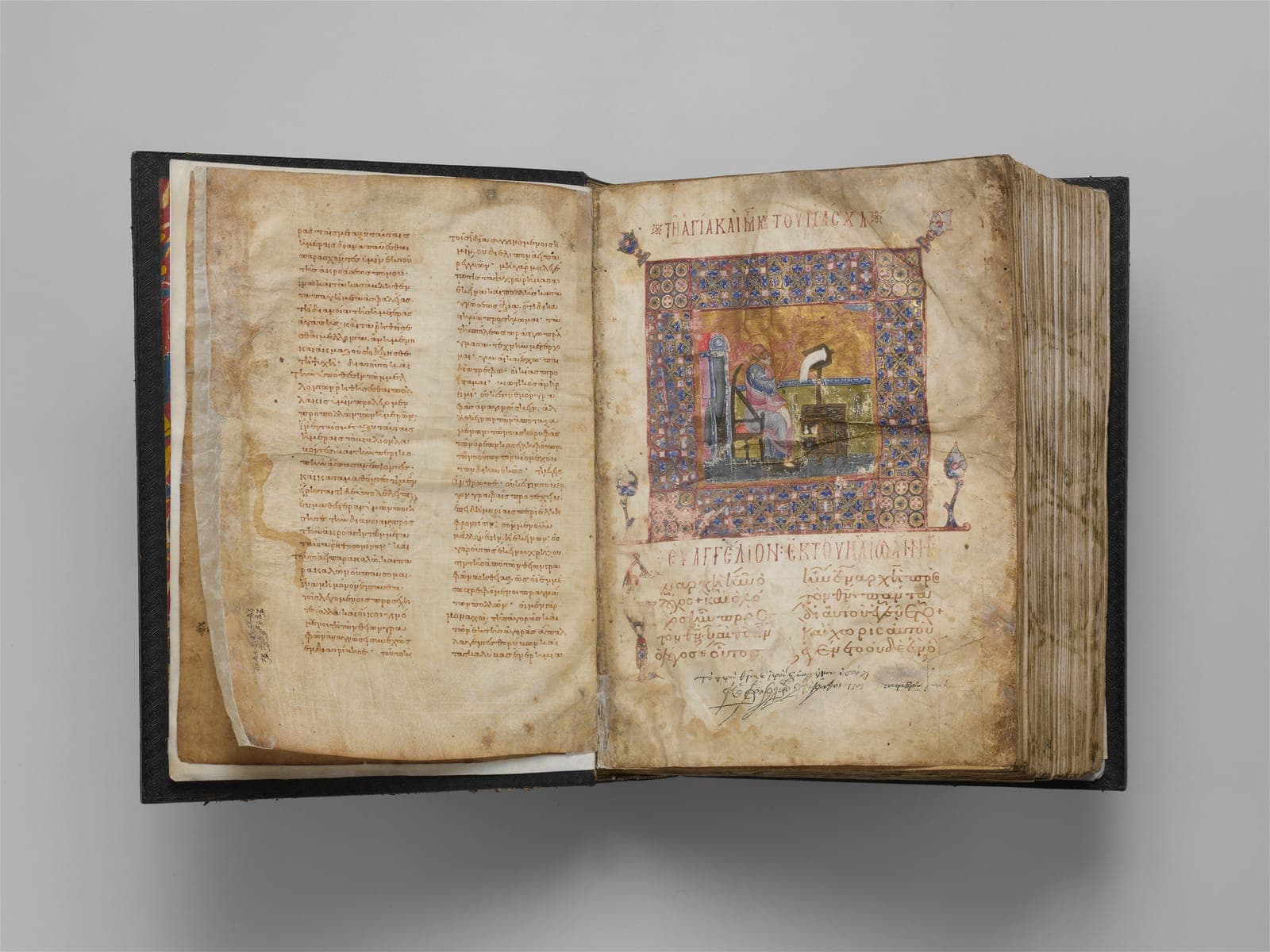
Historical origins and the early church
Christianity began within the Jewish world of the first century. The New Testament Gospels present Jesus as teacher, healer and Messiah, and the earliest Christian communities proclaimed his crucifixion and resurrection as central to the meaning of his life. The movement spread through the eastern Mediterranean and beyond, developing forms of worship, leadership, teaching and communal discipline.
Over the following centuries, Christian communities formed creeds, liturgies, monastic traditions and theological schools. Major disputes concerned questions such as the identity of Jesus, the Trinity and the authority of church leaders. The later separation between the churches conventionally called Eastern Orthodox and Roman Catholic developed through a long history rather than one isolated event. The Protestant Reformation then produced multiple reform movements rather than a single new centralized church.
Bible and scripture
The Bible is Christianity's foundational scriptural collection. Christians share the New Testament and much of the Old Testament, but Catholic, Orthodox and Protestant canons are not identical. Translation, liturgical use and interpretation also differ.
The four Gospels hold a particularly important place because they narrate the life, teaching, death and resurrection of Jesus. Other New Testament writings include letters, historical narrative and apocalyptic literature. Christian communities read these texts within different authority structures: Catholic and Orthodox traditions situate scripture within the wider life and tradition of the church, while Protestant traditions characteristically give scripture a uniquely normative role in ways that still vary among denominations.
Jesus and Christology
Jesus is central to Christian identity in a way that cannot be reduced to his role as a moral teacher or historical founder. Mainstream Catholic, Orthodox and most Protestant traditions confess Jesus as the Christ and understand his identity through incarnation, death, resurrection and salvation.
Early Christian disputes about how to speak of Jesus' divinity and humanity led to creedal and conciliar formulations that remain important for many churches. Later traditions inherited that vocabulary but do not always explain salvation, atonement or the work of Christ with the same emphasis.
The Trinity and Christian difference
Catholic, Eastern Orthodox and most Protestant traditions are Trinitarian. They confess one God in relation to Father, Son and Holy Spirit, while rejecting the idea that Christianity worships three separate gods. The doctrine developed through sustained interpretation of scripture, worship and early theological controversy.
Trinitarian agreement does not erase every difference. Eastern and Western Christian traditions have disagreed over particular theological formulations, and Protestant churches use a wide range of confessional language. There are also communities that identify as Christian while using non-Trinitarian theological frameworks. It is therefore more accurate to say that Trinitarian belief is central to historic mainstream Christianity than to make it a test that describes every self-identified Christian group without qualification.
Worship, baptism and the Eucharist
Christian worship commonly includes prayer, scripture reading, preaching or teaching, singing and communal ritual. Baptism and the Eucharist or Lord's Supper are especially widespread, but Christians differ significantly over sacramental theology, frequency, terminology and who may administer or receive particular rites.
Catholic and Orthodox churches place sacramental life at the center of the church's worship. Many Protestant churches also practice baptism and the Lord's Supper while interpreting their meaning in different ways. Some emphasize sacramental grace, others covenant, remembrance or testimony, and many traditions combine several of these themes.
The church calendar is central in some communities and less prominent in others. Practices surrounding saints, icons, fasting, confession and devotional prayer likewise vary and often reflect deeper differences about church, authority and spiritual life.
Prayer and Christian life
Christian prayer can be spontaneous, liturgical, contemplative, communal or private. The Lord's Prayer is one of the most widely shared Christian prayers, while traditions also preserve their own daily offices, hymns, devotional practices and forms of meditation.
Catholic and Orthodox Christians may ask saints to intercede, distinguishing this from worship owed to God. Many Protestant traditions avoid invocation of saints and emphasize prayer addressed directly to God through Christ. Despite these differences, praise, thanksgiving, confession, petition and intercession are recognizable forms of prayer across a broad range of churches.
Catholic, Orthodox and Protestant communions
Roman Catholicism has a global episcopal structure centered on communion with the bishop of Rome. Eastern Orthodox Christianity is organized through self-governing churches that share doctrine and sacramental communion rather than through one universal pope.
Protestant Christianity includes many denominations and movements that emerged from or after the Reformation. Lutheran, Reformed, Anglican, Methodist, Baptist, Pentecostal and other traditions can differ over church government, sacraments, predestination, spiritual gifts, worship and the relationship between faith and works.
These three broad families are useful, but they are not internally uniform. Eastern Christianity also includes Oriental Orthodox and other ancient churches whose histories do not fit neatly into a simple Catholic-Orthodox-Protestant diagram.
In brief
Three broad families, none of them uniform
Catholic
A global episcopal structure centered on communion with the bishop of Rome.
Eastern Orthodox
Self-governing churches that share doctrine and sacramental communion, without one universal pope.
Protestant
Many denominations and movements — Lutheran, Reformed, Anglican, Methodist, Baptist, Pentecostal and others.
Salvation, ethics and discipleship
Christians commonly speak of sin, grace, faith, reconciliation with God, resurrection and eternal life. Traditions organize these themes differently. Catholic, Orthodox, Lutheran, Reformed, Methodist, Baptist and Pentecostal accounts can place different emphases on justification, sanctification, sacramental life, participation in divine life, assurance, free will and predestination.
Christian ethics are likewise connected to scripture, worship, community and understandings of discipleship. Churches may reach different conclusions on disputed moral questions while still drawing on shared texts and theological language.
Christianity as a global tradition
Christianity is practiced in many languages and cultural settings, and no single region defines the whole tradition. Churches in Africa, Asia, Europe, the Middle East, the Americas and Oceania have distinct histories and lived expressions.
Culture influences music, architecture, festivals, political relationships and community organization, but cultural similarity does not guarantee theological agreement. A Catholic parish in two countries may look very different while sharing sacramental and ecclesial structures; two Protestant churches in the same city may look similar while holding different doctrinal commitments.