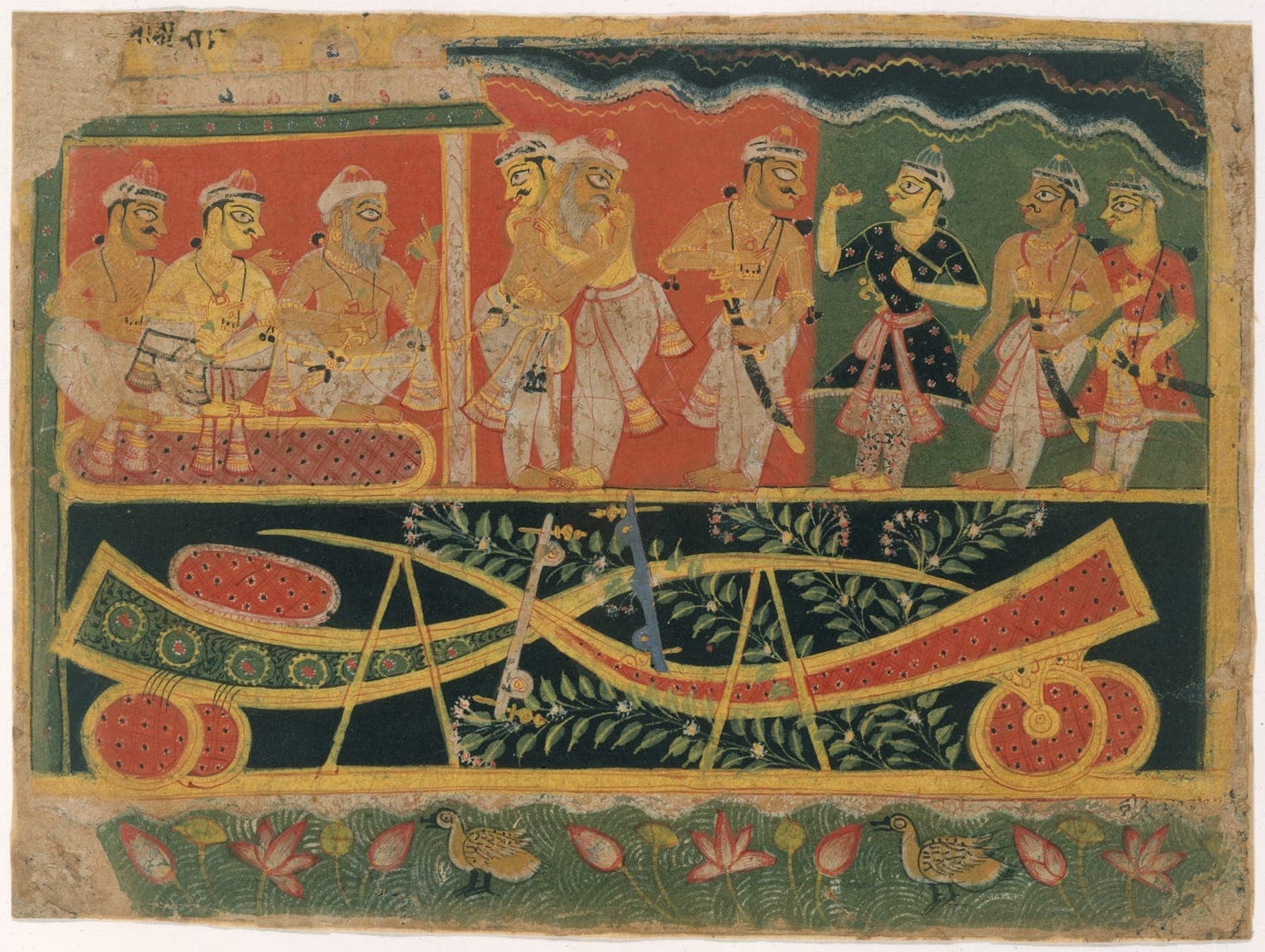
Historical development without a single-founder story
Hindu traditions developed across a very long history in South Asia. Vedic ritual and textual cultures form an important early layer, while later Upanishadic, epic, devotional, temple, philosophical, tantric, regional and vernacular traditions added new forms of religious life.
There is no single historical moment that functions as the founding event for all Hinduism and no single founder who plays the role that a founder may play in some other religions. Continuity exists alongside reinterpretation, regional development, new devotional movements and philosophical debate.
The word "Hinduism" is therefore an umbrella for traditions with deep historical connections rather than the name of one centralized organization.
Textual plurality: Vedas, Upanishads, epics and more
Hindu religious authority is textually plural. The Vedas are foundational to many understandings of Hindu tradition, and the Upanishads became especially important for reflection on ultimate reality, self and liberation.
The Mahabharata and Ramayana are major epic traditions, and the Bhagavad Gita, contained within the Mahabharata, has become one of the most widely read Hindu texts. Puranic literature, devotional poetry, philosophical commentaries, Agamas, Tantras and lineage-specific texts can also be central in particular communities.
This means that neither "the Vedas" nor "the Bhagavad Gita" should be described as if it were the one book used in the same way by every Hindu. A text can be highly authoritative without being the sole scripture of all Hindu traditions.
The divine: one, many and beyond simple labels
Hindu traditions speak about the divine through many theological frameworks. Brahman can refer to ultimate reality, while terms such as Ishvara and Bhagavan are used in theistic settings. Devotional communities may center worship on Vishnu or forms associated with Vishnu, on Shiva, on Devi in her many forms, or on other deities.
Labels such as "monotheistic," "polytheistic," "henotheistic" and "monistic" can illuminate particular Hindu positions but become misleading when used as universal descriptions. Some traditions understand different divine forms in relation to one ultimate reality; others place a particular deity at the center of devotion and theology.
The diversity is not evidence that Hinduism has no theology. It means that multiple theological systems exist within the wider tradition.
Major devotional and philosophical traditions
Vaishnava traditions center devotion on Vishnu and forms such as Krishna or Rama. Shaiva traditions center Shiva, while Shakta traditions place the Goddess or Devi at the center of religious life. These broad families contain their own lineages, temples, teachers and philosophical differences.
Vedanta is another important family of philosophical traditions drawing especially on the Upanishads, Bhagavad Gita and Brahma Sutras. Vedanta schools disagree about the relationship among Brahman, the individual self and the world. Other classical philosophical systems address logic, ritual, metaphysics, meditation and liberation from different perspectives.
No single institution or teacher can therefore be treated as the universal voice of Hinduism.
In brief
Families of tradition, side by side
Vaishnava
Devotion centered on Vishnu and forms such as Krishna or Rama.
Shaiva
Devotion centered on Shiva.
Shakta
The Goddess, Devi, at the center of religious life.
Vedanta
Philosophical schools drawing especially on the Upanishads, Bhagavad Gita and Brahma Sutras.
Karma, dharma and moksha
Karma, dharma and moksha are widely important terms, but their meanings cannot be exhausted by one sentence. Karma concerns action and consequences, while different schools explain its operation and theological setting differently.
Dharma can refer to duty, ethical order, religious practice, social responsibility, teaching or the sustaining order of life depending on context. It can describe broad moral ideals as well as responsibilities connected with a particular stage or role in life.
Moksha names liberation from the cycle of rebirth, but traditions differ over what liberation is, how it is attained and how the liberated self relates to ultimate reality. Devotion, knowledge, disciplined action and meditative practice can be emphasized in different combinations.
Puja, temples and home worship
Puja is a common form of worship involving acts such as offerings, lamps, incense, recitation and reverence before a deity. It may take place in a temple, at a home shrine or in other devotional settings.
Temple worship can include darshan, the act of seeing and being seen by the deity, as well as offerings, festivals and rituals conducted by priests. Home practice may be simpler or highly developed depending on family tradition. Some Hindus participate regularly in temple life, while others center practice around household ritual, meditation, study, pilgrimage or devotional singing.
A practice can be widespread without being obligatory for every Hindu.
Yoga, meditation and disciplined paths
Yoga in Hindu traditions refers to far more than modern physical exercise. Hindu texts and schools use the term for disciplined paths that can involve ethics, meditation, bodily practice, devotion, knowledge and control of attention.
The Bhagavad Gita, for example, presents multiple forms of yoga connected with action, knowledge and devotion. Later yoga traditions developed their own techniques and philosophies. Contemporary global yoga has drawn selectively from these histories, so a modern exercise class should not be treated as a complete description of Hindu religious yoga.
Festivals, pilgrimage and sacred geography
Hindu life includes many festivals, but observance varies by region and community. Diwali, Holi, Navaratri and festivals centered on particular deities are celebrated in different ways and may carry different theological emphases.
Pilgrimage and sacred geography are also important. Rivers, temples, mountains and cities can become places of religious memory and devotion. Local sacred landscapes matter greatly, which is another reason regional Hindu practice can differ without losing connection to broader traditions.
No single creed or central institution
Hinduism has no worldwide institution that can issue a creed binding on all Hindus. There are major temples, monastic orders, sampradayas, philosophical lineages, reform movements, teachers and community organizations, but none can be treated as the sole contemporary authority for the tradition as a whole.
Religious authority may come from texts, inherited lineages, gurus, temple traditions, philosophical schools, family custom and community practice. Different communities give these sources different weight.
Regional and lived diversity
Hindu life is shaped by language, region, family tradition, caste and community histories, migration, temple networks and modern institutions. Cultural practice and religious doctrine overlap, but they are not identical.
A regional custom should not automatically be described as a universal theological requirement. A deity may be highly prominent without being central to every community, and a philosophical idea may be influential without being accepted in the same form by every school.
Hinduism therefore holds two facts together: there are recognizable shared histories and concepts, and there is no single formula that replaces the tradition's internal plurality.